What Are the Best Karaoke Machines for Home Use? Guide
What Are the Best Karaoke Machines for Home Use?
Short answer: the “best” depends on your room size, neighbors, microphones (how many and which RF band), connectivity and latency path, effects, and ease of setup and daily use. This guide answers the question “what are the best karaoke machines for home use” with a decision framework rather than a random list. We define objective criteria, show a simple test protocol you can replicate at home in minutes, then present category picks for real scenarios (apartments, living rooms, basements/garages, patios) with clear pros and cons. Use this to narrow to the right system type, verify lip-sync and feedback behavior, and make a confident, low-risk choice for your home.
Choose by Scenario (Start Here)
Apartment Quiet Night
- Room size: up to ~12 m² (bedroom, small studio or 1-bed living area).
- Key constraints: thin walls, quiet hours, limited space, small TV.
- Features that matter: vocal clarity at low volume, minimal bass bleed (smaller drivers, gentle EQ), very fine volume steps and quick, simple setup.
Family Living Room
- Room size: ~12–25 m².
- Key constraints: mixed ages, frequent setup/teardown, storage, remote/app control.
- Features that matter: fast start (HDMI ARC or optical), two wireless mics for duets, kid-friendly controls, safe loudness with clear speech.
Party Basement/Garage
- Room size: ~25–40 m² (or larger, semi-treated space).
- Key constraints: higher SPL headroom, multiple singers, echoes from hard surfaces.
- Features that matter: larger drivers (8–10"), simple mixer with EQ/echo, feedback control, extra inputs (guitar/line).
Portable Patio/Backyard
- Area: outdoor seating, small yard, or balcony.
- Key constraints: power access, carrying gear, neighbors across fences.
- Features that matter: battery operation, easy carry handles, weather-aware placement tips, quick-charge, conservative bass to avoid projecting over fences.
System Types (Know Your Options)
All-in-One Box
What it is: speakers + mic receiver + basic effects in a single unit.
- Pros: fastest setup, minimal cables, living-room friendly, often includes two wireless mics.
- Cons: less expandable than separates; deepest bass and effect depth are limited.
- I/O: AUX/line-in common; some support optical/HDMI via extractor; Bluetooth for convenience (watch latency).
- Ideal for: apartments and family rooms that value simplicity and low-volume clarity.
Soundbar + Mic Hub
What it is: keep your TV soundbar; add a compact mic receiver/mixer that feeds the bar.
- Pros: clean living-room look, great TV integration, strong dialog clarity.
- Cons: input mapping can be fiddly; mic hub quality determines latency and effects.
- I/O: HDMI ARC/eARC or optical to the bar, mic hub via AUX/optical (model-dependent), Bluetooth optional.
- Ideal for: family living rooms where TV use and karaoke share the same space.
Compact PA + Mixer
What it is: a pair of small PA speakers (5–10") with a simple mixer providing echo/reverb and EQ.
- Pros: best headroom and control, multiple inputs, easiest feedback management.
- Cons: more pieces and cables; requires stands and storage.
- I/O: HDMI audio extractor/optical from TV to mixer; mics via UHF/2.4 GHz receivers; line/guitar inputs.
- Ideal for: basements/garages or large living spaces hosting groups.
Smart TV/Tablet + Dual Wireless Mics
What it is: app-driven karaoke (e.g., YouTube/app) plus a simple mic receiver feeding TV/speakers.
- Pros: cheapest to start; flexible library.
- Cons: highest risk of lip-sync delay if everything is wireless; sound limited by TV speakers.
- I/O: HDMI to TV; audio via ARC/optical/AUX; Bluetooth as convenience only.
- Ideal for: casual users testing the waters before upgrading.
The Scoring Rubric (Weighting)
Score each category from 0–5, then apply the weight and total to 100.
- Sound clarity & loudness control — 20% (vocal intelligibility at low/moderate volume; fine volume steps).
- Microphones (RF stability, clarity, feedback resistance) — 20% (dropout resistance; on-mic mute; how soon feedback occurs).
- Connectivity & latency — 20% (ARC/eARC/optical options; ability to keep video/lyric sync).
- Ease of setup & daily use — 15% (time from box to singing; labeling; remote/app usability).
- Effects & vocal tools — 10% (echo/reverb quality; key change; basic EQ usefulness).
- Portability & build — 10% (battery option, handles, weight, durability).
- Expandability — 5% (extra inputs: guitar, USB/TF/AUX; additional mic inputs).
How we measure: (1) Lip-sync with a clap test on a TV lyrics video; (2) Mic feedback walk to identify gain before squeal; (3) Clarity read at speaking level to catch sibilance/boxiness; (4) Duet trial to confirm two voices remain distinct; (5) Neighbor test for intelligibility at low volume; (6) Battery check with a 30-minute run at lively volume (if applicable).
At-Home Tests You Can Replicate (5–10 Minutes)
- Lip-Sync Check: play a YouTube karaoke track on the TV, record a single clap on your phone, replay in slow motion, and observe delay.
- Mic Feedback Walk: raise mic gain slowly while you walk a semicircle in front of the speakers; note where squeal starts and back off one notch.
- Clarity Read: speak a pangram at normal level; listen for boxiness (200–400 Hz) and sharp sibilance; apply small EQ cuts.
- Duet Trial: two mics at once; confirm both are intelligible without pumping or distortion.
- Neighbor Test: step into the hallway/stairwell; at a reduced volume, speech should be understandable without booming bass.
- Battery Reality: if portable, run 30 minutes at “party volume,” note the drop, and estimate real-world runtime.
Best Karaoke Machines for Home Use — Category Winners (2025)
Each pick is framed generically to match common market options. Use the rubric above to validate a specific model you’re considering.
Best for Apartments (Low-Volume Clarity)
- Why it wins: smaller drivers (5–6.5") voiced for speech clarity at modest levels, precise volume control, and restrained bass to reduce wall transmission.
- Who it’s for: studio/1-bed dwellers, late-night singers, neighbors nearby.
- Trade-off: limited deep bass and maximum SPL compared with larger systems.
Best Family-Friendly Living Room Setup
- Why it wins: fast HDMI ARC or optical path for reliable AV sync, two wireless mics included, simple echo/volume knobs, and remote/app control.
- Who it’s for: families who want plug-and-sing convenience and safe loudness.
- Trade-off: effects depth and input flexibility are less than a full mixer rig.
Best Party-Ready Basement/Garage Rig
- Why it wins: compact PA pair (8–10") on stands, basic mixer with EQ/reverb, multiple inputs for mics/instruments, strong feedback control.
- Who it’s for: larger rooms and groups who want energy and headroom.
- Trade-off: more gear and cables; needs storage space.
Best Portable Patio/Backyard Box
- Why it wins: integrated battery, carry handles, quick-charge, and tuned mids that carry outdoors without blasting low bass over fences.
- Who it’s for: patios, porches, small yards, and casual outdoor gatherings.
- Trade-off: convenience over ultimate fidelity; watch Bluetooth delay if you use it.
Best Value All-in-One Home Machine
- Why it wins: balanced basics at a sensible cost: two wireless mics, clear vocal EQ, basic echo, and simple connectivity for TV/phone.
- Who it’s for: first-time buyers who want reliable living-room performance.
- Trade-off: limited max loudness and fewer deep-dive controls than separates.
A Home-Friendly Pick to Consider (Balanced & Easy)
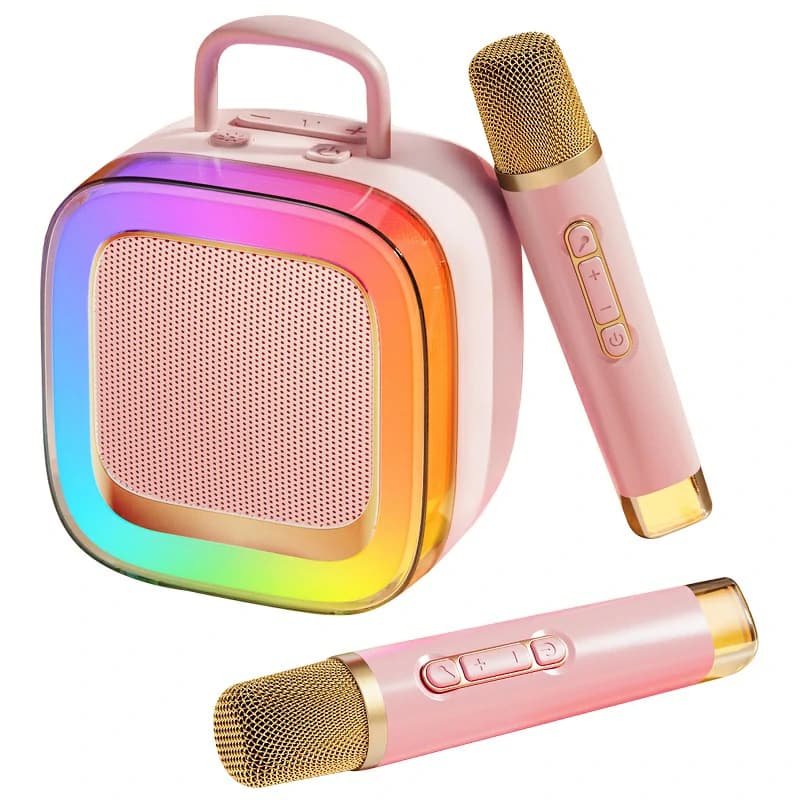
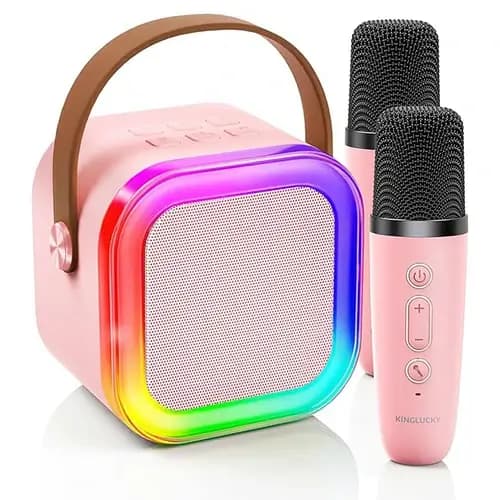
For many households, a compact all-in-one with two wireless microphones is the most practical starting point. Helpful attributes include Bluetooth input for casual music playback, multiple inputs (AUX/USB/TF) so you can connect a TV, laptop, or phone, and Type-C charging for convenience. Small dual speakers with sensible output power are enough for a living room when paired with simple mic volume and echo knobs. Battery capability (roughly a few hours of music) lets you move from room to patio without hunting for outlets. In real use, these traits mean fast setup, stable duet performance, and clear vocals at family-friendly volumes—ideal for answering “what are the best karaoke machines for home use” when simplicity and everyday usability matter most.
Connectivity & Latency Basics (Home = Lip-Sync First)
- Prefer wired paths: TV to audio via HDMI ARC/eARC or optical reduces lip-sync issues compared with Bluetooth.
- Mic chain: receiver → mixer/box → speaker; keep speakers in front of singers and angle them away to reduce feedback.
- Bluetooth caution: it’s convenient for music, but can add delay for karaoke lyrics. If you must use BT, keep the chain short and look for low-latency modes.
Comparison Table — Home Essentials at a Glance
| System Type | Room Fit | Mics Included | Latency Path (TV→Audio) | Effects | Battery | I/O (HDMI/Opt/BT/AUX/USB/TF) | Notable Trade-off |
|---|---|---|---|---|---|---|---|
| Apartment Box | Small | 2 wireless | Optical/ARC preferred; BT optional | Echo, basic EQ | Optional | BT, AUX, USB/TF; HDMI via extractor | Limited deep bass; wins on clarity |
| Family All-in-One | Small–Medium | 2 wireless | ARC/eARC or Optical | Echo/reverb; key change on some | Sometimes | HDMI (via extractor), Optical, BT, AUX | Less expandable than separates |
| Party PA | Medium–Large | 2+ via mixer | Fully wired (lowest latency) | Mixer EQ + reverb | No | HDMI extractor, Optical, XLR/TRS | More gear; needs stands/storage |
| Patio Battery Box | Small–Medium/Outdoor | 2 wireless | AUX wired preferred; BT ok for music | Echo, simple EQ | Yes | BT, AUX, USB/TF | Convenience over ultimate fidelity |
| Soundbar + Mic Hub | Small–Medium | 2 wireless (hub) | ARC/eARC or Optical | Hub-dependent | No | HDMI, Optical, AUX | Input mapping can be fiddly |
| Smart TV + Dual Mics | Small | 2 wireless | Often mixed (higher delay) | App-based | No | HDMI to TV; AUX to bar | Easiest start, weakest control |
Setup Blueprints (From 10 Minutes to Party-Ready)
10-Min Quick Start
- Smart TV → soundbar via ARC; dual wireless mics into the bar’s AUX (or a small mic hub).
- Set echo lightly; confirm lip-sync with a quick clap test.
30–45 Min Family Build
- All-in-one box with two mics; TV via optical/ARC or short-hop BT for casual music.
- Calibrate mic gain and echo; keep volume neighbor-safe.
60+ Min Party Build
- Compact PA pair on stands + small mixer (EQ/reverb); TV audio via HDMI extractor to the mixer.
- Place speakers ahead of singers; notch EQ if feedback appears.
FAQs
Do I need a subwoofer for home karaoke?
Not usually. Clear mids and presence matter more for lyrics. In small rooms, subs can annoy neighbors; in larger rooms, use a modest sub at low level.
How do I minimize lip-sync delay with YouTube karaoke on TV?
Prefer HDMI ARC/eARC or optical for TV→audio, and keep the mic chain wired into the same path. Avoid multiple wireless hops.
Are dual wireless mics reliable in apartments?
Yes, with good RF design. UHF avoids Wi-Fi bands; robust 2.4 GHz with frequency-hopping also works. Keep receivers away from routers and metal shelves.
What’s the difference between echo and reverb?
Echo is a distinct repeat; reverb is a dense sense of space. Start short and subtle—if words blur, reduce time/mix.
How loud is too loud for neighbors?
If speech is fully intelligible through a wall or in a hallway, you’re too loud. Use speaker placement and EQ for clarity instead of turning up the master.
Can I plug in a guitar or use it for small acoustic jams?
Yes, if your unit or mixer has an instrument/line input. Keep levels conservative and use light reverb for blend.
Conclusion
The best karaoke machines for home use are the ones that fit your room size, neighbor constraints, microphone needs, and latency path—not the biggest watt number. Choose the system type for your scenario first, then apply the weighted rubric and quick at-home tests to validate clarity, sync, feedback resistance, and everyday usability. That method turns “what are the best karaoke machines for home use” into a confident, data-backed choice for your home.
Recommended Products