What’s the Best Karaoke Machine to Get? A No-Guesswork Guide
What’s the Best Karaoke Machine to Get?
Short answer: the best karaoke machine is the one that balances lip-sync accuracy, microphone clarity, room size, neighbor limits, and ease of setup for your situation. This guide uses a simple flow—quiz → method → test → picks—so you can narrow the field, understand the trade-offs, and then validate any option at home in minutes. Instead of a generic top-10, you’ll map your space and signal chain, apply a weighted rubric, run a 5-minute test plan, and choose the system archetype (all-in-one, soundbar+hub, compact PA, or portable/mini) that truly fits your room, guests, and routine.
Start Here — 3 Questions That Decide 80% of the Choice
- Where will you use it most? Apartment / Living Room / Den or Basement / Patio or Backyard / On-the-go
- Two microphones at once? Duets and parties vs. solo practice
- Lyrics source & path? TV apps with ARC/eARC/optical, or phone/tablet via Bluetooth/line-in
How it maps: Apartments favor clarity at low volume and tiny footprints. Dens and basements benefit from headroom and more control. Patios/backyards need portable power and battery. Duets require two stable wireless mics. TV-based lyrics call for ARC/eARC/optical to reduce latency; phone/tablet paths are fine for casual use but can add delay via Bluetooth.
System Archetypes (Pick by What You Actually Need)
All-in-One Box
- Pros: Fastest setup; single carry; built-in effects and dual mic receivers.
- Watch-outs: Limited deep EQ or routing; bass headroom is modest in smaller cabinets.
- Best-fit: Small–medium rooms, casual living-room sessions, quick family nights.
Soundbar + Mic Hub
- Pros: Clean living-room look; one HDMI to the TV; easy daily use.
- Watch-outs: Confirm ARC/eARC for tight lip-sync; usually not battery-portable.
- Best-fit: TV-centric karaoke where tidy aesthetics and lip-sync matter most.
Compact PA + Small Mixer
- Pros: Most headroom; better mic preamps and EQ; multiple inputs (instruments, tracks).
- Watch-outs: More pieces and cables; longer setup; bulkier storage.
- Best-fit: Dens/basements and party spaces where control and output matter.
Portable/Mini Battery Unit
- Pros: Grab-and-go; battery power; two wireless mics common; USB-C charging.
- Watch-outs: Limited deep bass by design; simpler EQ.
- Best-fit: Apartments, kids’ rooms, travel, quick backyard sing-alongs.
The Weighted Scoring Rubric (0–5 × weight)
| Category | Weight | How to Judge Quickly |
|---|---|---|
| Connectivity & Lip-Sync Path | 25% | Use TV’s ARC/eARC/optical where possible; run the clap-on-camera test below. |
| Wireless Mic Performance | 20% | Stable, low hiss, minimal dropouts through a room loop; feedback resistance with speakers kept ahead. |
| Vocal Clarity at Home-Friendly Volume | 15% | Consonants stay crisp with light echo; speech remains intelligible without shouting. |
| Ease of Setup & Guest-Proofing | 15% | Power on → pair mics → play track in <60s; obvious knobs for mic, music, echo. |
| Room/Neighbor Fit | 15% | Right size for space; sounds good at conversation-plus; tears down quickly if needed. |
| Expandability & I/O | 10% | AUX/USB/TF, possible instrument in; optional recording or mix-out if you stream. |
Scoring: Rate each 0–5, multiply by weight, sum to 100. Anything ≥80 fits most homes; ≥90 usually means the path and room match is excellent.
The 5-Minute Home Test Plan (Replicable)
- Lip-Sync Test (1 min): Play a karaoke video on your TV. Record yourself clapping once near your face. Compare HDMI ARC/optical vs TV→Bluetooth; pick the path with the tighter alignment.
- Mic Feedback Walk (1 min): Put speakers in front of the singers. Bring mic gain up slowly and walk a loop. Note the point of first squeal and keep levels comfortably below it.
- Clarity Read (1 min): Say a pangram (e.g., “Pack my box with five dozen liquor jugs”). Dial in a light echo so consonants stay defined, not splashy.
- Duet Stress (1 min): Two mics at once; both voices should remain intelligible with music playing.
- Neighbor Check (1 min): Step to the hallway/porch at “conversation-plus” volume. If speech is too intelligible outside the room, back off 2–3 dB.
Connectivity That Actually Works (Why “Best” = Low Latency)
- TV → speaker via Bluetooth often adds noticeable delay. Prefer HDMI ARC/eARC or optical when you care about tight lip-sync.
- For phone/tablet sources, pre-test the app and path; minimize extra DSP or audio hops.
- Signal chain basics: mic receiver → mixer/effects → speaker; keep modest gain and place speakers ahead of the mics to reduce feedback.
Scenario Winners (With Candid Trade-Offs)
Best for Apartments (Quiet-Hour Friendly)
Why it wins: Clear vocals at low volume, tiny footprint, quick teardown. For who: Renters and late-night singers. Trade-off: Limited deep bass and party-level output—by design.
Best Family Living Room
Why it wins: Two stable wireless mics, tasteful echo, clean TV integration via ARC. For who: Families rotating singers on movie nights. Trade-off: Not battery-portable; confirm your TV’s ARC/eARC.
Best Den/Basement Party
Why it wins: Compact PA + small mixer gives headroom, inputs for instruments, and better EQ. For who: Hosts with a dedicated space. Trade-off: More setup time and gear to store.
Best Patio/Backyard Portable
Why it wins: Battery power, carry handle, simple controls. For who: Casual outdoor gatherings. Trade-off: Wind noise on mics and limited sub-bass outside—use windscreens and smart placement.
Best Kids/Travel Mini
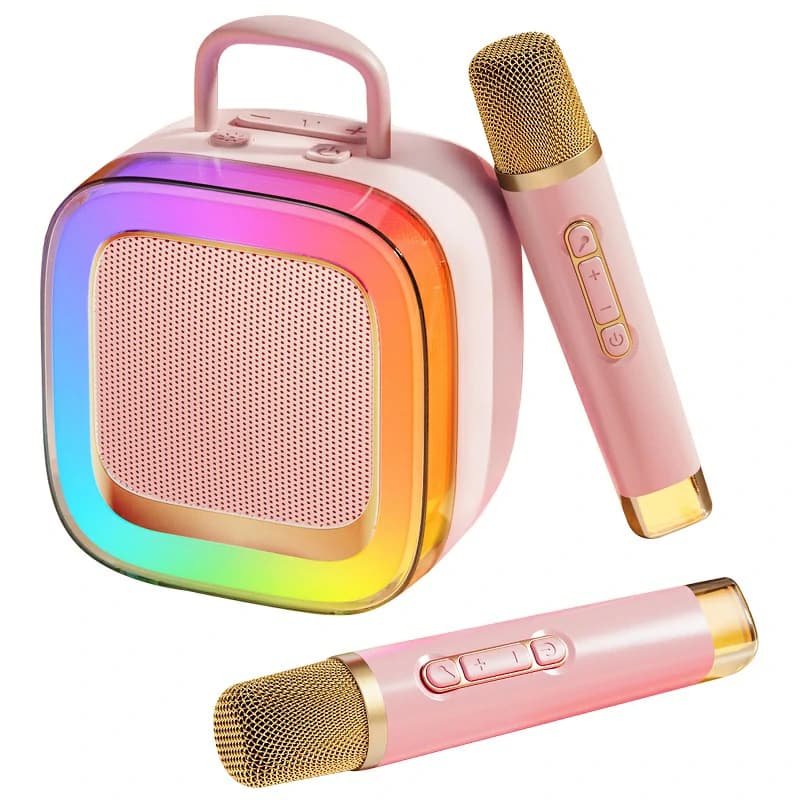
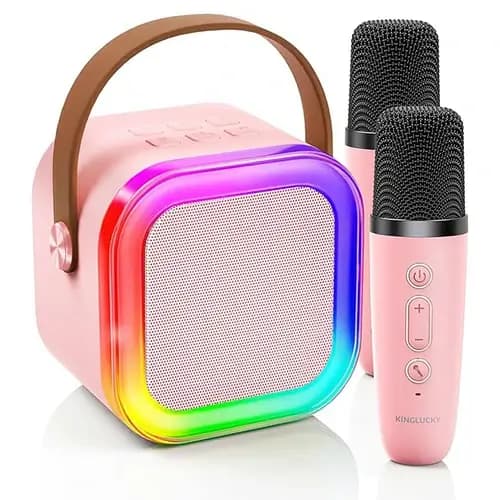
Why it wins: Portable all-in-one with two wireless mics, USB-C charging, simple echo and fun voice effects; easy Bluetooth for tracks; designed for “indoor-voice” volumes and quick duets. Trade-off: Bass is modest; that’s acceptable for bedrooms and playrooms.
Kids/Travel Mini — Feature Illustration (Neutral Example)
When evaluating a kids/travel mini, look for: two wireless mics with quick pairing, Bluetooth 5.x for tracks, Type-C charging, battery power, echo on/off, simple voice effects (e.g., female/male/monster/chipmunk), TF card for offline songs, and moderate LED lights. As a neutral feature example, a unit like Kinglucky K88 combines Bluetooth 5.3, two wireless mics, echo toggle, LED lights, Type-C, TF card, DSP/HIFI processing, multiple “magic voice” modes, battery power (5V DC), and scenarios such as party, outdoor, birthday, and home—illustrating how a compact system can serve family play and on-the-go use without deep setup.
Quick Comparison Table — Match Yourself to a Path
| Path | Room Fit | Latency Path | Mics | Effects | Battery | Pros | Watch-Out |
|---|---|---|---|---|---|---|---|
| All-in-One | Small–Medium | ARC/Optical | Dual wireless | Echo | Optional | Fastest start | Limited deep EQ |
| Soundbar + Hub | Small–Medium | ARC/eARC | Dual wireless | Light echo | No | Clean look | Confirm ARC |
| Compact PA | Medium–Large | Wired/Optical | 2–4 | Echo/EQ | Optional | Headroom & control | Setup time |
| Portable/Mini | Small–Small+ | App/BT or ARC | Dual | Echo + fun FX | Yes | Grab-and-go | Limited deep bass |
Buying Checklist (Deal-Breakers vs Nice-to-Haves)
- Deal-Breakers: Tight lip-sync path for your lyrics source; two stable wireless mics if you duet; clear mic/music/echo knobs; sounds good at conversation-plus.
- Nice-to-Haves: USB-C top-ups, TF/USB for offline tracks, instrument input, tasteful LEDs, carry handle/strap, washable windscreens.
FAQs
Do I need a subwoofer for home karaoke?
No. Vocal clarity matters more than deep bass at home. If music feels thin, modest bass enhancement helps, but keep volumes neighbor-friendly.
How do I avoid TV Bluetooth lip-sync delay?
Use HDMI ARC/eARC or optical from the TV to your system. Verify by recording a clap test and comparing paths.
Are two wireless mics reliable in Wi-Fi-dense apartments?
Look for systems with robust wireless links and test a “room loop” for dropouts. Keep receivers in line of sight and away from routers if possible.
Echo vs reverb — what’s tasteful in a living room?
Light, short echo keeps consonants crisp. Heavy effects smear speech and make neighbors notice.
What’s a realistic battery runtime at indoor-voice levels?
Expect several hours on compact units at modest volume. High output or outdoor use shortens runtime; keep a USB-C charger handy.
Can I livestream my session with an all-in-one?
Some offer mix-out or USB recording, but many don’t. If streaming matters, prioritize systems with line-out or an interface-friendly mixer.
Conclusion
What’s the best karaoke machine to get? It’s the one whose connectivity (lip-sync), dual-mic clarity, room/neighbor fit, and setup speed match your everyday reality. Use the quiz, weighted rubric, and 5-minute tests above to verify any model at home, then choose the archetype—all-in-one, soundbar+hub, compact PA, or portable/mini—that aligns with your space, your guests, and your routine.
Recommended Products