Do Karaoke Machines Have Autotune? The Real Answer

Do Karaoke Machines Have Autotune?
Short answer: most home karaoke machines do not include full Auto-Tune® like studio plug-ins. Many offer basic real-time pitch correction or only key change/transpose. Nearly all include echo/reverb, and some add voice-morph effects (e.g., male/female/monster/chipmunk). At consumer price points, correction—when present—tends to be gentler, with limited controls and some latency. Expect helpful “pitch assist,” not pro-studio precision.
Terms You Must Not Confuse
- Auto-Tune® (brand): Studio-grade, per-note pitch correction aligned to a musical scale. Rare in home boxes.
- Real-time pitch correction: Simplified tuner that nudges your voice toward scale tones. Less control; may mis-track on fast runs.
- Key change / transpose: Shifts the song’s key. Does not fix your pitch.
- Pitch-shift / harmony: Adds or shifts by intervals (e.g., +3 semitones). Not corrective.
- Vocal cancel: Reduces lead vocal in a stereo track. Doesn’t tune your voice.
- FX (echo/reverb/voice-morph): Adds space or character (female/male/monster/chipmunk). Changes timbre, not accuracy.
What Consumer Karaoke Units Commonly Include
Entry-level karaoke boxes center on echo/reverb, mic-volume and key-change knobs.
Mid-tier machines add basic pitch-assist labeled Auto Pitch or Vocal Tune.
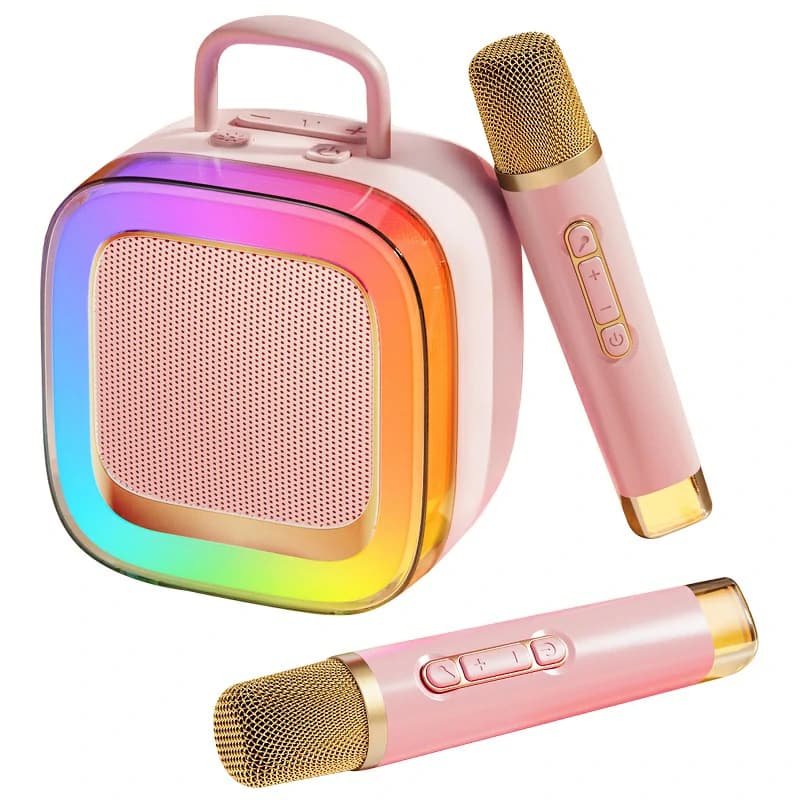
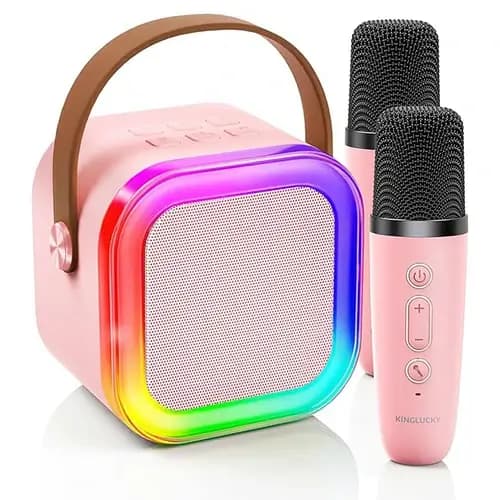
“Party feature” systems—like the Kinglucky K88—combine:
-
Dual wireless microphones
-
Echo switch and volume control
-
DSP chip for Hi-Fi sound
-
Magic Voice effects: female, male, monster, chipmunk, original
-
Bluetooth 5.3, Type-C, TF card, and LED lights
These effects alter tone color or ambience but not note accuracy—because they lack per-note pitch mapping.
Do Any Home Systems Have Real-Time Pitch Correction?
Yes, but they’re less common and simpler than studio software. Look for terms like pitch correction, auto pitch, vocal tune, key assist, or anti-flat/anti-sharp in manuals. Trade-offs include latency, limited scales, and tracking errors on fast melismas or wide vibrato.
How to Tell What Your Machine Actually Does (At-Home Tests)
- Test A — Key Change vs Correction: Shift song key ±2 semitones and speak a monotone “la.” If your voice doesn’t “lock” to notes, it’s key change only.
- Test B — Real-Time Correction: Sing a slow major scale and drift slightly flat/sharp. If output “snaps” toward scale tones with a gentle glide, correction is active.
- Test C — Latency Check: Clap while monitoring your mic through speakers; audible delay indicates higher latency.
- Test D — FX vs Tune: Toggle echo/reverb/voice-morph only; if pitch accuracy doesn’t change, they’re effects—not tuning.
Signal Path & Latency Basics
Mic → preamp → DSP (FX/pitch) → amp/speakers. Real-time correction needs fast DSP. TV lyrics and Bluetooth audio can add delay; for tighter sync, prefer HDMI ARC/eARC or optical where available. Set mic gain for a clean signal and avoid pointing mics at speakers to prevent feedback.
Feature Spectrum (Comparison Table)
| Feature | What it does | Corrects singer’s pitch? | Typical on home units | Latency sensitivity |
|---|---|---|---|---|
| Echo/Reverb | Adds room/space | No | Always | Low |
| Key Change | Moves song key | No | Often | Low |
| Voice Morph | Changes timbre/character | No | Often | Low |
| Real-Time Pitch Correction | Nudges voice toward scale tones | Yes | Sometimes | High |
| Harmony | Adds fixed intervals | No (unless tied to tuner) | Rare | High |
Decision Flowchart — Do You Need Auto-Tune or Just Effects?
- Party fun/duets? → Echo + voice-morph + key change are enough.
- Pitch practice? → Look for an explicit “Pitch Correction/Auto Pitch” control and verify with the scale test.
- Livestream/recording? → Prioritize low-latency signal path (ARC/optical/wired monitor) and predictable correction; consider a small mixer or audio interface if needed.
Buying Checklist for “Autotune-like” Needs
- Manual claims: exact terms—“pitch correction,” “auto pitch,” scale/key options.
- Controls: amount/speed/scale; easy bypass switch.
- Latency: do the clap test; avoid Bluetooth for mic monitoring when possible.
- Microphones: dual wireless, good SNR, pop/wind filtering, stable band (UHF/2.4 GHz).
- I/O: Bluetooth fine for music in; use ARC/optical/wired for low-latency monitoring.
- Portability & power: battery life, USB-C charging; party features (LEDs) as desired.
Honest Expectations vs Pro Studio “Auto-Tune”
Consumer correction is assistive—good for gentle smoothing, not studio polish. Fast runs, extreme vibrato, or noisy rooms can break tracking. Use moderate correction to avoid robotic artifacts.
FAQs
Do karaoke machines come with real Auto-Tune?
Usually no. Some include simpler real-time pitch correction.
What’s the difference between key change and pitch correction?
Key change shifts the song; pitch correction adjusts your voice.
Why does Bluetooth add delay?
Bluetooth buffers audio packets; wired/ARC paths reduce latency.
Can I get harmony effects at home?
Occasionally, but it’s uncommon; most consumer units focus on echo, reverb, and morphing.
How do I quickly test if my box corrects pitch?
Sing a slow major scale and drift slightly off; if it “snaps” toward notes, tuning is active.
Will voice-morph make me sound in tune?
No—morphing changes character, not accuracy.
Conclusion
Most home karaoke machines don’t include full Auto-Tune. Many provide effects (echo, key change, voice-morph) and some offer basic real-time pitch correction. Use the tests above to confirm what your device does, and choose based on latency needs, available controls, and whether your goal is party fun, practice, or recording.
Recommended Products