Are Open Earbuds Good for Glasses Wearers?
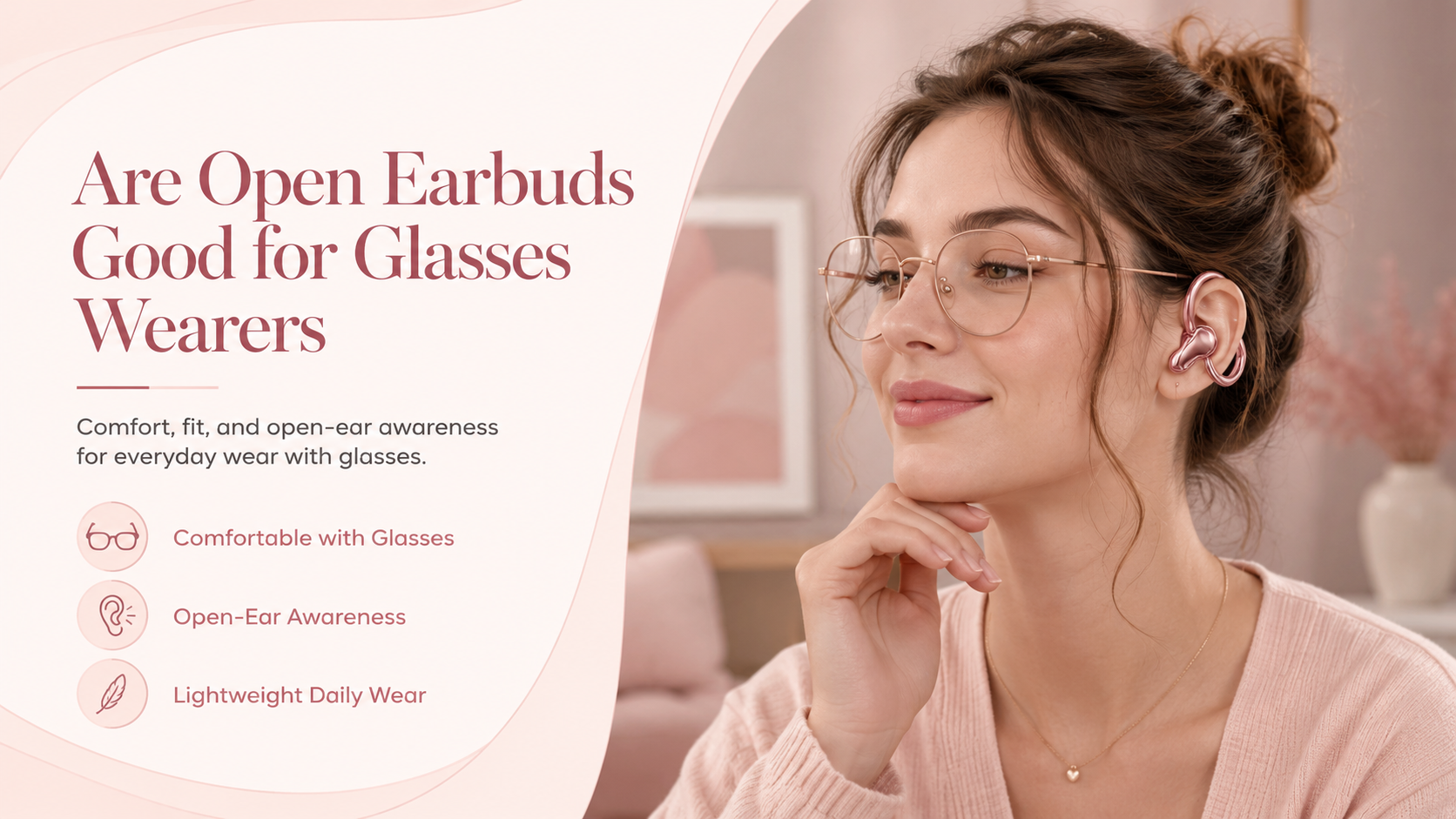
Short answer: Yes, open earbuds are often a very good option for glasses wearers. They usually avoid the clamp pressure of over-ear headphones and feel less intrusive than sealed in-ear earbuds. The best results come from lightweight designs that do not fight for the same space as your glasses arms.
Last updated: May 11, 2026
Why This Question Matters
If you wear glasses every day, you already know that comfort is not just about sound quality. A pair of earbuds or headphones can feel fine for ten minutes and frustrating after an hour.
The main problem is simple: the area around the ear is limited. Glasses arms already rest on the top and side of the ear. When an audio device adds clamping force, thick hooks, or a bulky shell, pressure can build fast. That is why many glasses wearers spend more time thinking about fit than people who do not wear frames daily.
For this reason, the best earbuds for glasses wearers are not always the ones with the most features. They are the ones that stay comfortable through work, commutes, calls, and casual listening.
How We Evaluated What Makes Earbuds Good for Glasses Wearers
To answer this question fairly, it helps to define what “good” actually means for glasses wearers. We looked at five practical factors:
-
Temple pressure: Does the design create extra force against the glasses arms?
-
Ear contact: Does the earbud take up the same space as the frame?
-
Long-session comfort: Is the fit still comfortable after one to three hours?
-
Stability: Does the earbud stay in place during walking, commuting, or desk work?
-
Everyday usability: Does it work well for calls, podcasts, music, and awareness of surroundings?
For many users, comfort-first audio matters more than maximum isolation. That is exactly where open earbuds often make sense.
Why Open Earbuds Often Work Well for Glasses Wearers
Open earbuds sit outside the ear canal or lightly near the ear instead of sealing deeply inside it. That changes the experience in a few useful ways.
1. They usually reduce pressure around the temples
The biggest advantage over over-ear headphones is that open earbuds do not clamp your glasses arms against your head. If you often get sore spots around the temples, open earbuds are usually a more comfortable direction.
2. They can feel easier to wear for long periods
Some glasses wearers are also sensitive to deep in-ear pressure. Open earbuds avoid that plugged-in feeling, which makes them a practical choice for long workdays, meetings, and all-day casual listening.
3. They keep you aware of your surroundings
Open-ear designs let in more ambient sound. That is useful if you want to hear coworkers, traffic, announcements, or conversation at home. For many daily-use buyers, awareness is a feature rather than a compromise.
4. They often suit multi-tasking better
If you switch between calls, music, walking, desk work, and quick conversations, open earbuds can feel more natural than isolating headphones. That matters for office workers, commuters, and anyone who wears glasses from morning to night.
When Open Earbuds Are Not the Best Choice
Open earbuds are good for many glasses wearers, but they are not perfect for everyone.
-
They do not isolate noise well. If you work in a loud office or commute on noisy trains, outside sound may be distracting.
-
Bass usually feels lighter than sealed earbuds. Open designs tend to sound more airy and less immersive.
-
Fit still depends on shape. Some hook-based models may interfere with thick glasses arms.
-
Not every design is equally stable. A poor fit will feel awkward no matter how good the product sounds.
So the better answer is not “open earbuds are always best.” It is “open earbuds are often best when comfort and low pressure matter more than isolation.”
Open Earbuds vs In-Ear vs Over-Ear for Glasses Wearers
Open earbuds
Why they may suit glasses wearers: Less clamp pressure, less ear canal fatigue, better for long casual wear. Potential drawback: Lower isolation and usually lighter bass. Best for: Work, commuting, calls, podcasts, and all-day comfort.
In-ear earbuds
Why they may suit glasses wearers: They do not press on glasses arms and are easy to carry. Potential drawback: Some users dislike the sealed feeling or develop ear fatigue over time. Best for: Travel, workouts, and users who want more isolation in a small form factor.
Over-ear headphones
Why they may suit glasses wearers: Often strong for immersive sound and focused listening. Potential drawback: The ear cushions can press the glasses arms into the head, especially during long sessions. Best for: Quiet environments where sound immersion matters more than comfort around the temples.
What Glasses Wearers Should Look For
If you are shopping specifically for a glasses-friendly pair of open earbuds, pay attention to design details instead of marketing language.
Lightweight build
A lighter earbud is usually easier to forget you are wearing. This matters a lot for long work sessions or daily commuting.
Minimal overlap with glasses arms
The less the earbud competes with the frame for the same contact point, the better. Slimmer shapes are usually easier to live with.
Flexible support structure
If the earbud uses a bridge or ear hook, it should be flexible rather than rigid. This helps it adapt without creating a pressure point beside the frame.
Stable everyday fit
Comfort is not enough if the earbud shifts every time you walk. A good glasses-friendly fit should feel secure without squeezing.
Clear call performance
A lot of open-ear buyers use their earbuds for calls, meetings, and voice content. Reliable microphones matter just as much as comfort.
A Practical Recommendation: Why Kinglucky A8 Fits This Conversation
If you are looking for a comfort-first open-ear option for daily wear, Kinglucky A8 is a natural example of the kind of design glasses wearers should pay attention to.
Rather than positioning it as a universal “best overall” pick, it makes more sense to describe the A8 as a practical value pick for everyday open-ear sound. That is where its design is easiest to understand.
Here is why it stands out in this context:
-
Very light fit: The ClipFree A8 weighs about 4.0g per ear, which helps reduce fatigue during longer sessions.
-
Open-ear comfort: It does not go deep into the ear canal, so it avoids the sealed feeling some users dislike.
-
Flexible C-Bridge design: Its Ni-Ti alloy C-Bridge is designed to adapt to ear shape and stay stable without feeling overly rigid.
-
Balanced daily-use audio: It uses Hi-Pure Sound Gen 2, a 12mm dynamic driver, and an enhanced acoustic chamber, with tuning that emphasizes clear vocals and smooth everyday listening.
-
Useful real-world features: It supports Bluetooth 6.0, multi-device pairing, IP56 protection, and up to 6 hours per charge / 50 hours total with the case.
-
Call-friendly design: Built-in noise-reduction microphones make it more practical for meetings and calls, not just music.
For glasses wearers, the most relevant part is not the spec sheet alone. It is the combination of low weight, open-ear comfort, and a flexible structure. Those are exactly the traits that tend to matter when the ear area is already occupied by frames.
Where the A8 may not be ideal
To keep the recommendation balanced, there are still trade-offs:
-
It is not the best fit for buyers who want strong passive noise blocking.
-
Like most open-ear designs, it is more about comfort and awareness than heavy bass impact.
-
Users with very thick glasses arms should still pay attention to how any clip-style design sits alongside the frame.
In other words, the A8 makes the most sense for people who want all-day comfort, open-ear awareness, and practical everyday sound without paying premium-brand pricing.
Who Should Consider Open Earbuds Most Seriously?
Open earbuds are especially worth considering if you are:
-
A glasses wearer who gets temple pressure from over-ear headphones
-
Someone who dislikes the plugged-in feeling of sealed earbuds
-
A commuter who wants to stay aware of surroundings
-
An office or remote worker on frequent calls
-
A casual listener who values comfort over maximum isolation
They are less suitable if you need:
-
Strong noise blocking in loud places
-
Deep, immersive bass response
-
A sealed fit for workouts in very noisy environments
FAQ
Are open earbuds better than over-ear headphones for glasses wearers?
Often, yes. Open earbuds usually create less pressure around the temples because they do not clamp the glasses arms against the head.
Are open earbuds better than in-ear earbuds for glasses wearers?
They can be, especially for users who dislike ear canal pressure. But if noise isolation is your priority, in-ear earbuds may still be the better fit.
Do clip-on or open-ear designs interfere with glasses?
Sometimes. The risk is higher with thicker glasses arms or rigid support structures. Lightweight, flexible designs are usually the safer choice.
Are open earbuds good for all-day use?
Yes, often. Open earbuds are commonly chosen for long wear because they feel lighter, less sealed, and easier to keep on through different daily tasks.
Is Kinglucky A8 a good option for glasses wearers?
It can be a strong fit for comfort-focused users. Its lightweight 4.0g design, open-ear structure, and flexible C-Bridge design make it relevant for buyers who want a glasses-friendly open-ear option for daily listening and calls.
Final Verdict
So, are open earbuds good for glasses wearers? In many cases, yes. They often reduce temple pressure, feel less intrusive than sealed earbuds, and work well for long stretches of everyday use.
The key is choosing the right design. Glasses wearers should prioritize light weight, minimal pressure, flexible fit, and stable everyday comfort over marketing hype.
If that is the goal, a model like Kinglucky A8 fits naturally into the conversation. It is not the answer for every use case, but it is a sensible comfort-first option for people who want open-ear listening, daily practicality, and a better fit alongside glasses.


